
(Why the world’s most memorable brands feel less like companies—and more like personalities we instinctively understand)
There’s a reason people describe brands the way they describe people.
Some brands feel wise and reassuring.
Some feel bold and rebellious.
Some feel playful and energetic.
Some feel luxurious, romantic, disciplined, adventurous, nurturing, or quietly dependable.
And interestingly, customers recognise these personalities instinctively—even when the brand never explicitly states them.
That’s because human beings naturally make sense of the world through patterns and personalities. We are constantly categorising people, stories, and experiences emotionally. Over time, the strongest brands in the world have learned something profound: customers do not simply buy products. They build relationships with personalities.
This is where brand archetypes become incredibly powerful.
Archetypes help brands move beyond surface-level marketing and uncover something much deeper—the emotional role the brand plays in people’s lives. They provide a framework for shaping positioning, personality, communication, design, customer experience, and even decision-making.
More importantly, archetypes prevent brands from becoming forgettable.
Because the moment a brand begins copying the tone, language, or behaviour of competitors without understanding its own personality, it slowly starts dissolving into the category instead of standing apart from it.
What Exactly Is a Brand Archetype?
The idea of archetypes comes from psychologist Carl Jung, who believed that human beings instinctively recognise certain universal personality patterns. These patterns appear repeatedly across mythology, storytelling, religion, films, literature, and culture because they resonate deeply with human psychology.
Brands use these same patterns to create familiarity and emotional connection.
For example:
- When we see a brand that constantly pushes limits and motivates people to achieve more, we instinctively recognise the Hero.
- When a brand speaks calmly, intelligently, and with authority, we recognise the Sage.
- When a brand feels rebellious, disruptive, and unapologetic, we recognise the Outlaw.
These personalities are not manufactured trends.
They are deeply human emotional patterns that people have responded to for centuries.
Why Archetypes Matter in Positioning
Many brands attempt to position themselves around features:
better quality, better service, better technology, better pricing.
But features can be copied.
Personality is much harder to replicate.
Archetypes help brands answer fundamental positioning questions:
- Who are we emotionally?
- How should customers feel when they interact with us?
- What role do we naturally play in our category?
- How should we speak?
- What kind of visual language suits us?
- What kind of customers are drawn toward us instinctively?
Without this clarity, brands often drift into inconsistency. One campaign sounds premium, another sounds casual, the website feels corporate, social media feels trendy, and packaging feels unrelated altogether.
Archetypes bring coherence.
They align the entire brand around a recognisable emotional centre.
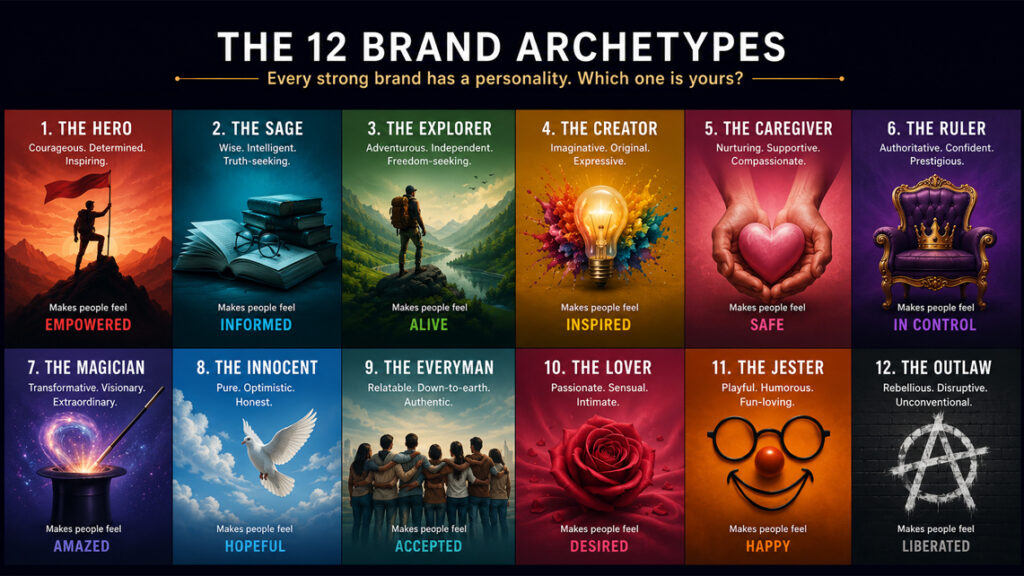
1. The Hero
The Hero archetype thrives on courage, achievement, discipline, and pushing limits. These brands make people feel stronger, more capable, and ready to overcome challenges.
Examples:
- Nike — “Just Do It” is pure Hero energy.
- Tata Motors (especially trucks/SUV communication) — strength, endurance, toughness.
- Gatorade — performance under pressure.
2. The Sage
The Sage seeks truth, clarity, expertise, and wisdom. These brands simplify complexity and position themselves as trusted guides.
Examples:
- Google — the world’s information guide.
- The Hindu — thoughtful, analytical, knowledge-led tone.
- LinkedIn — professional growth through knowledge and insight.
- IBM — calm intelligence and expertise.
3. The Explorer
The Explorer values freedom, discovery, movement, and pushing boundaries. These brands inspire people to step outside routine.
Examples:
- Jeep — freedom and adventure.
- Woodland — rugged exploration and outdoor identity.
- Airbnb — discovering places and experiences.
- GoPro — capturing adventure as it happens.
4. The Creator
The Creator thrives on originality, imagination, craftsmanship, and self-expression.
Examples:
- Adobe — empowering creativity.
- Asian Paints — transforming spaces creatively.
- LEGO — imagination made tangible.
- Canva — democratising design and creation.
5. The Caregiver
The Caregiver archetype protects, nurtures, reassures, and supports. These brands make people feel safe and cared for.
Examples:
- Johnson & Johnson — trust and care across generations.
- Apollo Hospitals — healthcare built around reassurance.
- Dove — emotional care and self-worth.
- Amul — warmth, nourishment, family familiarity.
6. The Ruler
The Ruler projects authority, prestige, order, and leadership. These brands create a sense of aspiration and control.
Examples:
- Mercedes-Benz — timeless authority and luxury.
- Louis Vuitton — status and exclusivity.
- Taj Hotels — refined hospitality and legacy.
- Rolex — prestige through precision.
7. The Magician
The Magician transforms reality and creates experiences that feel extraordinary, almost impossible.
Examples:
- Apple — technology made magical and intuitive.
- Disney — emotional transformation through storytelling.
- Dyson — engineering that feels futuristic.
- OYO Rooms (early years) — transforming fragmented hospitality into a standardised experience.
8. The Innocent
The Innocent believes in simplicity, purity, optimism, and honesty. These brands feel emotionally clean and uncomplicated.
Examples:
- Parle Products — nostalgic simplicity and trust.
- Paper Boat — innocence, memories, childhood emotion.
- Aveeno — gentle and natural care.
- Coca-Cola — happiness and togetherness.
9. The Everyman
The Everyman is relatable, grounded, practical, and approachable. These brands make customers feel included rather than impressed.
Examples:
- IKEA — everyday functionality for everyone.
- Reliance Retail — accessibility at scale.
- Maruti Suzuki — practical trust for everyday India.
- Levi Strauss & Co. — universal familiarity and comfort.
10. The Lover
The Lover archetype is built around beauty, desire, emotion, intimacy, and indulgence.
Examples:
- Titan Company (especially Tanishq campaigns) — emotional relationships and celebration.
- Chanel — elegance and timeless beauty.
- Cadbury — emotional indulgence and affection.
- Forest Essentials — sensory luxury rooted in care and beauty.
11. The Jester
The Jester brings humour, spontaneity, fun, and energy. These brands make people smile and feel lighter.
Examples:
- Fevicol — witty, memorable Indian humour.
- Zomato — playful and culturally sharp communication.
- M&M’s — fun-driven brand personality.
- Old Spice — absurd humour and entertainment.
12. The Outlaw
The Outlaw challenges norms, disrupts categories, and rejects convention. These brands thrive on boldness and rebellion.
Examples:
- Harley-Davidson — freedom and rebellion.
- boAt — youthful disruption in consumer electronics.
- Diesel — anti-establishment fashion identity.
How Archetypes Help Shape Positioning
The most powerful thing about archetypes is that they simplify decision-making across the entire brand ecosystem.
Once a brand understands its archetype, clarity begins to emerge naturally:
Communication becomes sharper
A Sage doesn’t speak like a Jester.
A Caregiver doesn’t behave like an Outlaw.
Visual identity becomes more cohesive
Typography, colours, imagery, layouts—all begin aligning emotionally.
Customer experience becomes intentional
Every interaction starts reinforcing the same emotional role.
Internal teams become aligned
Marketing, sales, leadership, and design stop pulling in different directions.
Archetypes transform positioning from a marketing exercise into a behavioural framework.
How We Use Archetypes in Positioning Research
In our work with brands, archetypes are never used as decorative labels. They are used as diagnostic tools to uncover how a company naturally behaves, where its strengths lie, and which emotional territory it can authentically own.
Sometimes the archetype is hidden inside the founders themselves.
A founder who speaks with clarity, precision, and deep expertise may naturally shape a Sage brand.
A company obsessed with customer support and trust may unknowingly operate as a Caregiver.
A disruptive startup challenging legacy systems may already carry the instincts of an Outlaw.
The goal is not to force-fit a personality.
The goal is to recognise the personality already present—and sharpen it into a distinct market position.
Because positioning becomes incredibly powerful when it feels natural rather than manufactured.
Final Thought
The strongest brands in the world do not merely sell products or services.
They occupy emotional roles in people’s minds.
People trust them like experts.
Follow them like leaders.
Love them like companions.
Admire them like icons.
Archetypes help brands understand which role they are truly meant to play.
And in a world where so many companies are trying desperately to sound alike, the brands that endure are usually the ones brave enough to fully become themselves.